Professional Tree Removal Services in West Columbia, SC
Call us
(803) 866-3855
Hours
Scheduled visits
Booked ahead, not promised at short notice
What the trees in West Columbia are doing
Tree Service in West Columbia, SC
West Columbia packs 8,818 homes into 9.41 square miles, which is the tightest arrangement of any town on this list. Most of those houses went up before 1980 and plenty before 1960, so a mature canopy is standing over lots that were surveyed when a car was narrower and a hedge was the only boundary. The practical result is a town where one limb coming down rarely affects one household. It takes the line, the shared drive, or the access to four more. Tree service West Columbia property owners ring us for is usually about a tree that has become a neighbourhood problem.
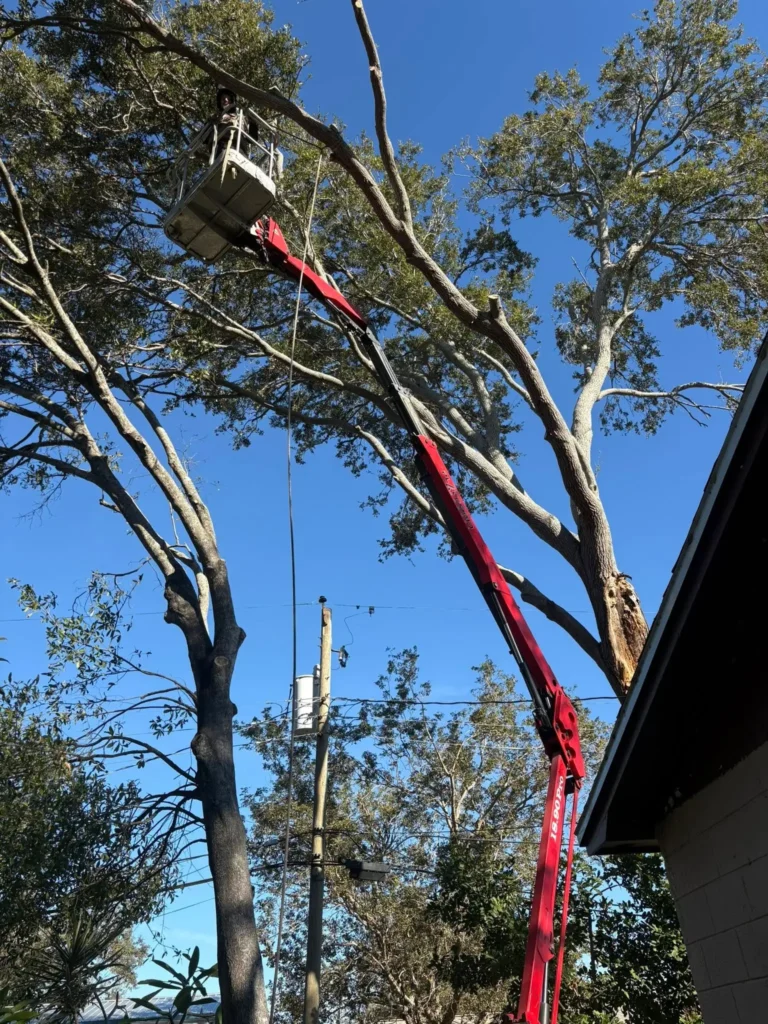
Homes in West Columbia and the trees around them
Nine and a bit square miles holding eight thousand homes
Density changes the arithmetic of a tree job. With 8,818 housing units inside 9.41 square miles, a great many properties share a fence, a driveway mouth, and a service drop, and the space between two walls is often the only route a machine could take. That means a good share of the work here is done on foot, from ladders and ropes, with a tarp laid to carry brush out rather than a chipper parked at the stump. None of it makes the job impossible. It makes it a planning exercise, and the plan starts with where a piece can land. Some of these yards have no gate wide enough for a barrow, so a tarp and a pair of hands carry the brush out along the same path the crew walked in on.
The 44.3 percent built before 1960
Nearly half the housing here predates 1960, and those houses came with trees that have been growing ever since. A pecan or an oak planted when the cottage was new is now the largest object on the property, wider than the house is tall, and its trunk is usually closer to the wall than the rules of the day would ever have allowed. Additions make it worse: a back room put on in the seventies or a carport added later often sits under a limb that has grown down toward it. Those are the trees we look at most carefully, because the clearance has quietly disappeared. What tends to happen is that the limb has been ignored for years, the newer growth has grown around it, and the only way to keep both tree and room is to take the limb back to a proper union.
Houses from the 1974 median year
The median home in West Columbia dates to 1974, which puts a large block of the town in the ranch-and-carport years. Those properties were laid out with a drive down one side and a yard behind, and the trees were set at the edges, which is why so many of them now lean over a parking pad rather than over grass. Such a tree has usually been trimmed once, badly, a long time ago, and the regrowth that followed is the part that fails. Reading an old pruning cut is most of the assessment on a 1974 lot. A flush cut leaves a pocket that holds water, and an upright shoot springing from the edge of one is attached by nothing but bark. Two of those on the same limb, both leaning toward the parking pad, is the arrangement that ends up on the ground.
What the county record shows about the wind here
The county’s National Weather Service entry for Helene is short on detail and long on consequence: timber and wires down together, roads impassable, power lost across sections of the county, several buildings struck, flooding in places, and gusts in the 70 to 80 mph range. The final tally for Lexington County was three houses lost outright and forty-one more damaged. In a town this compact, wind that reaches 70 to 80 mph does not need to be widespread to matter: a handful of stems crossing a few streets can close a route and cut power to a whole block at once. The flooding in that record matters too, because water standing in a yard softens the ground around every trunk on the street, and the trees that come through a wet storm are not always the ones that looked weakest beforehand.
Talk to us about a tree in West Columbia
Tell us the address, what the tree is doing and what has to stay open while the work happens. We will set a time to walk the property and put the scope in writing before anything is scheduled.
Tree work in West Columbia
Tree services in West Columbia
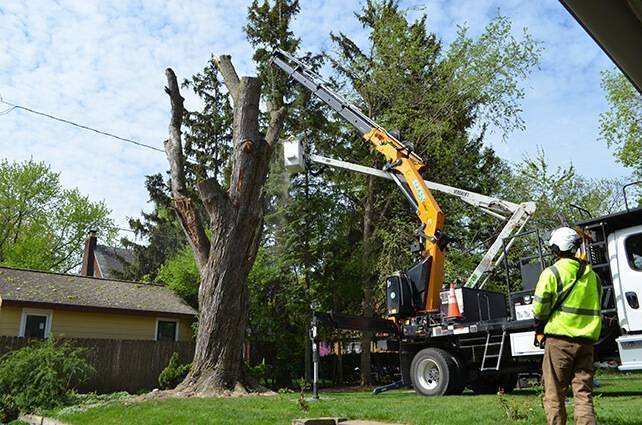
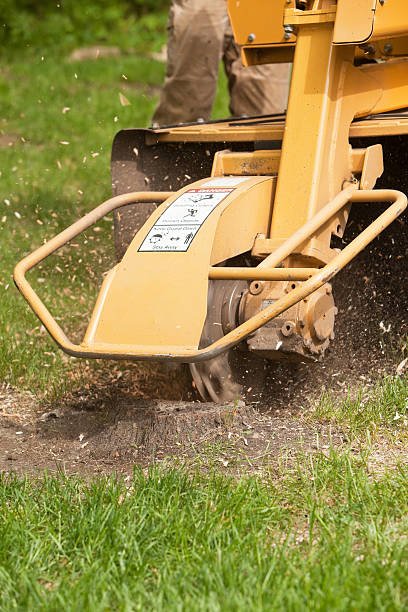
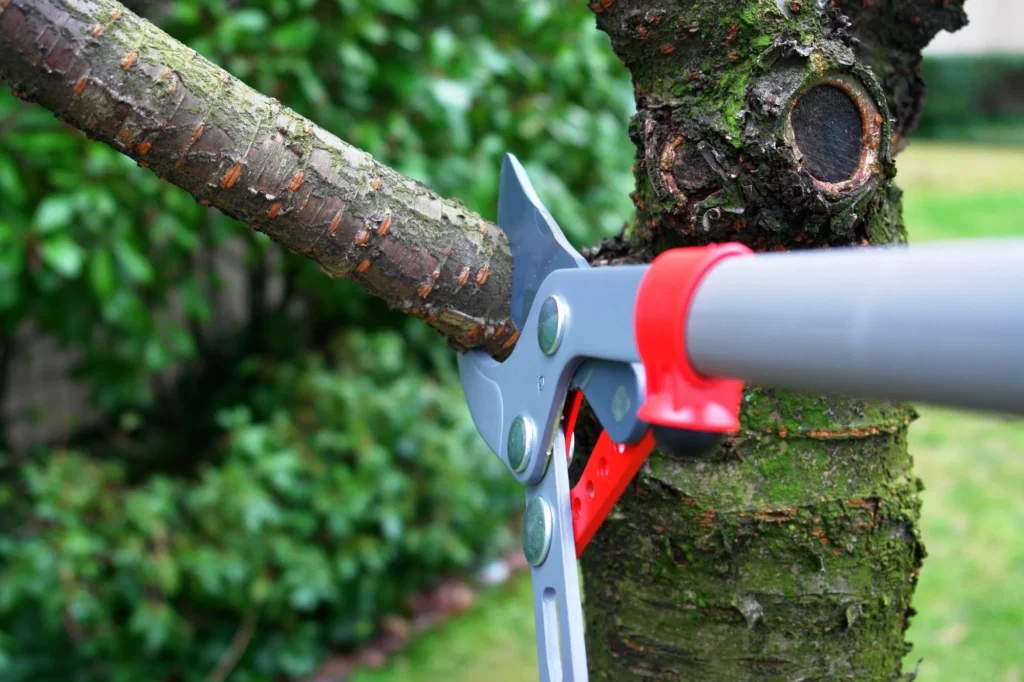
The tight footprint decides the order of work. Tree removal is the core job, and here it almost always means a climb-and-lower take-down rather than a fell: the stem is taken apart from the top, each piece tied off and lowered to a chosen spot, often a single parking space or the strip between two fences. Stump grinding follows, because on a lot this size the leftover stool is a trip hazard rather than a detail, and the space it opens is usually wanted for something. Tree pruning does the quieter work — clearance over a drive, deadwood out of a canopy, weight taken off a limb that hangs toward a wall.
Some properties need the broader jobs. Land clearing covers a back lot that has gone wild or ground being cleared for construction. Debris removal clears the stacks that build up behind a shed or along an alley, including the limbs from a previous storm that were cut and never moved. Emergency tree service is the call when a trunk is already down across a drive or a line. Commercial tree services keeps the frontage of the shops and offices on the main roads clear, where a fallen limb closes a doorway rather than filling a garden. Anything that sits behind a counter or a gate gets worked on a rhythm instead of a call-out.
One thing worth knowing about working here: access is decided by the neighbours as much as by you. A crew that needs to pass a car through a shared drive, or set a ladder in a space that belongs to the next property, will knock first. Sorting that out on the morning is the usual reason a job that should take a day spills into two.
We cover West Columbia and the towns it touches: Cayce to the south, Springdale close by, Lexington on the inland side, and Columbia across the water. Because the streets here run into each other without much warning, a job on one block frequently turns out to be two streets from the last one.
How a visit runs
- Walk the property and note what is at risk
- Check the base, the crown and the access
- Confirm what the city or county requires
- Put the scope in writing before the work
- Clear the debris and rake at the end
What we will not do
- We will not promise a response time we cannot keep
- We will not claim a credential we cannot show
- We will not give a figure for a tree nobody has seen
- We will not stack debris at the curb and call it cleared
- We will not cut a tree that can be pruned and kept
Why property owners in West Columbia work with us
Small lots under large trees mean most decisions here have a neighbour attached to them. A limb that overhangs a boundary, a stump that sits on a line, a root plate that has lifted a shared drive — these are the situations people want a straight answer about, and they want it before anyone starts a saw. We walk the property, look at what the tree is doing above and below ground, and say plainly which parts of the job are ours and where a conversation with the person next door needs to happen first. That order saves arguments later. It also means the work can be scoped honestly: on a lot this compact, one large tree can be most of a day, and knowing that in advance is more useful than discovering it at dusk, with the chipper still on the street and the neighbour’s car waiting to get out.
Fallen Tree Removal Columbia works from Mason Road in Columbia and covers West Columbia on the same schedule, so the walk, the scope and the crew come from the same place.
Why it matters now in West Columbia
The timing here is set by two numbers that pull in the same direction. The median home dates to 1974 and 58.7 percent of the stock went up before 1980, so the trees around most of this housing have been in place for the whole life of the property, and many have had no work beyond a limb taken off after a storm. At the same time the town is dense enough that a failure lands on something. Clemson’s storm-damage factsheet makes the point that the extent and type of damage decides whether a tree lives, which is the reason a split fork or a lifted plate is worth looking at now rather than after the next system comes through. An assessment on a calm day takes an hour; the same tree coming down in wind leaves a street without power and a household without a car. There is also a quieter reason to look now. On a lot of nine hundred square feet of grass, a canopy that has closed over the yard has already shaded out the lawn, and thinning the crown properly gives light back without losing the tree.
Tree work around West Columbia
Frequently
Asked
Questions
Does living on a small lot make a removal harder or easier?
Harder, in almost every case. A property inside the town’s 9.41 square miles usually has a narrow side strip, a shared drive, and a service drop within reach of the canopy, so there is no clear direction for a stem to fall. Everything comes down in sections on a rope, which takes longer and needs a spot for each piece. On a large lot the same tree might be felled in an afternoon.
My house dates from the seventies. What should I look at first?
Start with whatever hangs over the drive or the carport, since that is where a failure does damage rather than making a mess. On a 1974-vintage property the usual finding is a limb that was cut back hard decades ago and has since thrown several upright shoots from the cut; those shoots are weakly attached and grow heavy fast. Then look at the base for a lean that has changed. If the ground around the trunk has begun to show a crescent-shaped crack, stop trimming and get somebody to look at it properly, because that is a root plate moving rather than a branch problem.
How old is the housing stock here compared with nearby towns?
West Columbia’s median home dates to 1974, and 44.3 percent of the housing was standing before 1960. That is older than Lexington, where the median sits at 2003, and close to the profile in Cayce. The practical difference is canopy size: an older town has bigger trees over smaller yards, and the space between trunk and wall is what governs how the work gets done.
What can be done about a tree that leans over a boundary line?
Quite a lot, and the first step is establishing where the trunk actually stands. A stem rooted on your side is yours to deal with, even where the canopy hangs over a fence. Roots and overhanging limbs are a separate matter and usually need a word with the neighbour. We will tell you what we see and where the line falls before anyone climbs.
Does the town’s elevation affect how trees come out of the ground?
At roughly 283 feet, West Columbia sits above the lowest ground in the area but well below the ridge towns, and the soil here holds water after heavy rain. A root plate in wet ground gives way as a unit rather than snapping, which is why the storm record for the county mentions structures damaged by falling trees alongside the flooding. A tree that has been in saturated soil for a week is worth a second look.
Can the brush be left for the county collection?
Only in the sizes the service accepts — sticks and small limbs, in limited weekly amounts. Anything from a real take-down is far beyond that, so it leaves with us. If you want to keep some for firewood, we can cut straight sections to length and stack them where you want them; the rest goes on the truck in the same visit.
Harder, in almost every case. A property inside the town’s 9.41 square miles usually has a narrow side strip, a shared drive, and a service drop within reach of the canopy, so there is no clear direction for a stem to fall. Everything comes down in sections on a rope, which takes longer and needs a spot for each piece. On a large lot the same tree might be felled in an afternoon.
Start with whatever hangs over the drive or the carport, since that is where a failure does damage rather than making a mess. On a 1974-vintage property the usual finding is a limb that was cut back hard decades ago and has since thrown several upright shoots from the cut; those shoots are weakly attached and grow heavy fast. Then look at the base for a lean that has changed. If the ground around the trunk has begun to show a crescent-shaped crack, stop trimming and get somebody to look at it properly, because that is a root plate moving rather than a branch problem.
West Columbia’s median home dates to 1974, and 44.3 percent of the housing was standing before 1960. That is older than Lexington, where the median sits at 2003, and close to the profile in Cayce. The practical difference is canopy size: an older town has bigger trees over smaller yards, and the space between trunk and wall is what governs how the work gets done.
Quite a lot, and the first step is establishing where the trunk actually stands. A stem rooted on your side is yours to deal with, even where the canopy hangs over a fence. Roots and overhanging limbs are a separate matter and usually need a word with the neighbour. We will tell you what we see and where the line falls before anyone climbs.
At roughly 283 feet, West Columbia sits above the lowest ground in the area but well below the ridge towns, and the soil here holds water after heavy rain. A root plate in wet ground gives way as a unit rather than snapping, which is why the storm record for the county mentions structures damaged by falling trees alongside the flooding. A tree that has been in saturated soil for a week is worth a second look.
Only in the sizes the service accepts — sticks and small limbs, in limited weekly amounts. Anything from a real take-down is far beyond that, so it leaves with us. If you want to keep some for firewood, we can cut straight sections to length and stack them where you want them; the rest goes on the truck in the same visit.