Professional Tree Removal Services in Blythewood, SC
Call us
(803) 866-3855
Hours
Scheduled visits
Booked ahead, not promised at short notice

What the trees in Blythewood are doing
Tree Service in Blythewood, SC
A median build year of 2010 means most of the housing here went up in the last two decades, and very little of it predates 1980. That single figure explains most of the tree work in this town. These are not properties where a canopy was planted a century ago and a house grew up beneath it; they are lots cut out of standing timber, with the boundary trees left in place and the building dropped in beside them. Fifteen years on, the retained stems have reached the height that makes them matter. Tree service Blythewood households ask about is usually about that seam.
The homes in Blythewood and the trees around them
The boundary trees left standing when each lot was cut
Almost every street in this town ends in timber. The land was carved up in stages, and the clearing stopped where the grading stopped, which leaves a hard edge of pine and hardwood along the back fences and the unbuilt parcels in between. Trees that grew inside a stand lean on their neighbours for shelter, and once the stand is opened on one side, the stems at that edge carry a wind load they were never shaped to take. They also drift, slowly, toward the light. That is the tree people call about here: not a sick one and not an old one, but a sound tree that has been standing in the wrong place since the machine turned around.
Nine houses in ten are younger than 1980
Only 9.0% of the housing stock was standing before 1980, so the canopy and the houses arrived in the same decades. On a lot built in, say, 2015, the trees that were spared are now tall enough to reach the building but were never thinned, and they stand in tight clumps of four or five stems competing for the same light. In a group like that the losers are suppressed: long bare trunks, small crowns, wood that grew fast and soft in the shade. Take out the dominant stem in the middle and the suppressed ones beside it lose the tree they were leaning against. Thinning a young stand prevents that, and it is far easier at fifteen years than at forty. Dealt with now, a clump leaves one sound tree in a garden; left for twenty years, it is a removal with a fence to work around.
513.7 feet of open ground
At 513.7 feet this is high ground, and high ground changes what a storm does. There is less in the way of shelter up here than down on lower land, so wind arrives with more of its strength intact and finds the tallest thing on the skyline first. The county record from Hurricane Helene lists gusts of 60 to 70 mph across Richland County, with trees and lines down, some roads closed and sections left without power. What matters at this elevation is exposure rather than size. A pine on the windward edge of an open lot carries a heavier load than a thicker tree tucked behind a house and a hedge, and because the sheltered side does less work than the exposed one, the wood laid down each year is uneven and the crown sits off centre on the trunk.
2,108 homes across ten and a half square miles
Ten and a half square miles holding 2,108 housing units is a spacious town, and space complicates a tree job. Deep parcels mean the stem that worries a household can sit a long way back from the building and be rooted on a line that household does not own. It also means long shared boundaries, where one row of pines shades three gardens and leans on one of them. Each neighbour reads the risk differently, and usually only one has looked up lately. Because so much wooded ground survives between the built sections, a removal here often happens beside standing timber, so the drop zone is narrower than the crown suggests and the pieces come down in sections. On a parcel this deep the machine often cannot follow the crew in on the same visit, which is why grinding is usually booked alongside the take-down rather than after it.
Talk to us about a tree in Blythewood
Tell us the address, what the tree is doing and what has to stay open while the work happens. We will set a time to walk the property and put the scope in writing before anything is scheduled.
Tree work in Blythewood
Tree services in Blythewood
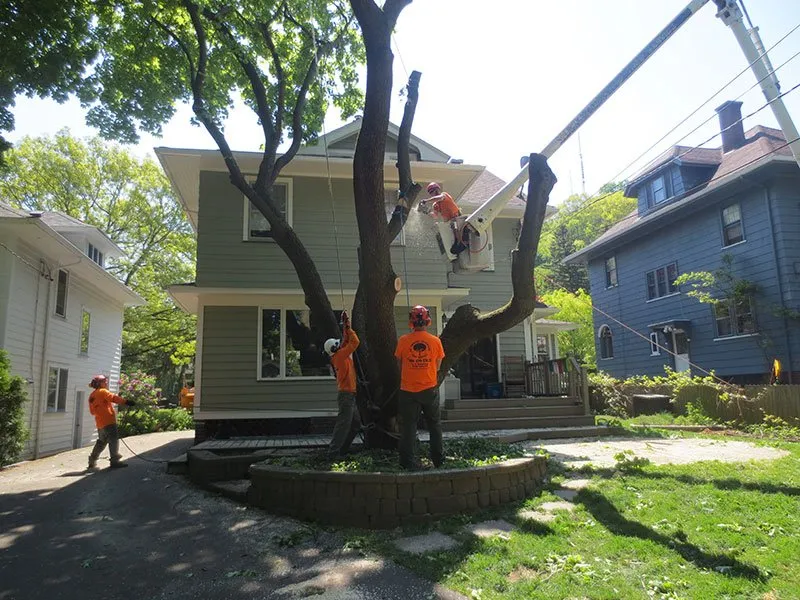
Most jobs here begin with a tree that is still healthy and in the wrong place, which is a different task from taking out something already dead. Tree removal on a lot with timber behind it means picking a drop side that does not put the stem into the standing timber, then working it down in sections and lowering the pieces instead of letting them run. The lower trunk stays as a hinge until the final cut, and the brush is processed where it lands so nothing has to be dragged across a garden. Where the stem leans over a shed or a parked car, it is tied off and lowered in short lengths, which takes longer and leaves the shed standing.
Stump grinding finishes the ground: the stool goes below the surface, the chips are spread or taken away, and the hole is left ready for soil and seed. Tree pruning is the other half of the same visit, and on a young tree it is about structure rather than tidiness — one leader kept, rival stems reduced, low limbs lifted clear of a path before they thicken into permanence. On the few parcels that predate the subdivisions, the job reverses: deadwood out of a wide crown, and clearance restored over a drive that has narrowed as the tree spread.
Land clearing covers the lot being opened up between two built ones, where a setback rather than a tree decides the boundary of the cleared area. Debris removal takes the sections, the rakings and the storm piles that have sat behind a fence since the last blow. Emergency tree service is for the trunk already down across a drive or a service line, and commercial tree services covers the frontages and car parks along the main routes, where a limb across the entrance takes a morning of trade with it.
We reach Blythewood from the north side of Columbia and work the surrounding places on the same runs: Irmo to the west, Elgin out in Kershaw County, and Columbia itself to the south. If two neighbouring properties share a line of pines, say so when you call, since both sides of a boundary can often be looked at in one visit.
How a visit runs
- Walk the property and note what is at risk
- Check the base, the crown and the access
- Confirm what the city or county requires
- Put the scope in writing before the work
- Clear the debris and rake at the end
What we will not do
- We will not promise a response time we cannot keep
- We will not claim a credential we cannot show
- We will not give a figure for a tree nobody has seen
- We will not stack debris at the curb and call it cleared
- We will not cut a tree that can be pruned and kept
Why property owners in Blythewood work with us
People here like their trees, and most of them kept the ones that came with the lot on purpose. That changes the conversation before a saw is started: which stem is the real problem, whether a lean can be corrected by taking weight off one side, whether the tree at the edge of the clearing can stay if its windward side is reduced. Fallen Tree Removal Columbia works on the view that a removal is the last answer rather than the first, and on a street where the trees are the reason the address is pleasant, that matters more than a fast decision. When a stem does have to go, it comes apart so the pieces land where the plan said, and the ground is left usable rather than rutted and stacked with cordwood. None of that is unusual. It is simply what a town built into its own woodland needs from whoever does the cutting.
Why it matters now in Blythewood
Two things meet in this town at the moment, and both can be dated.
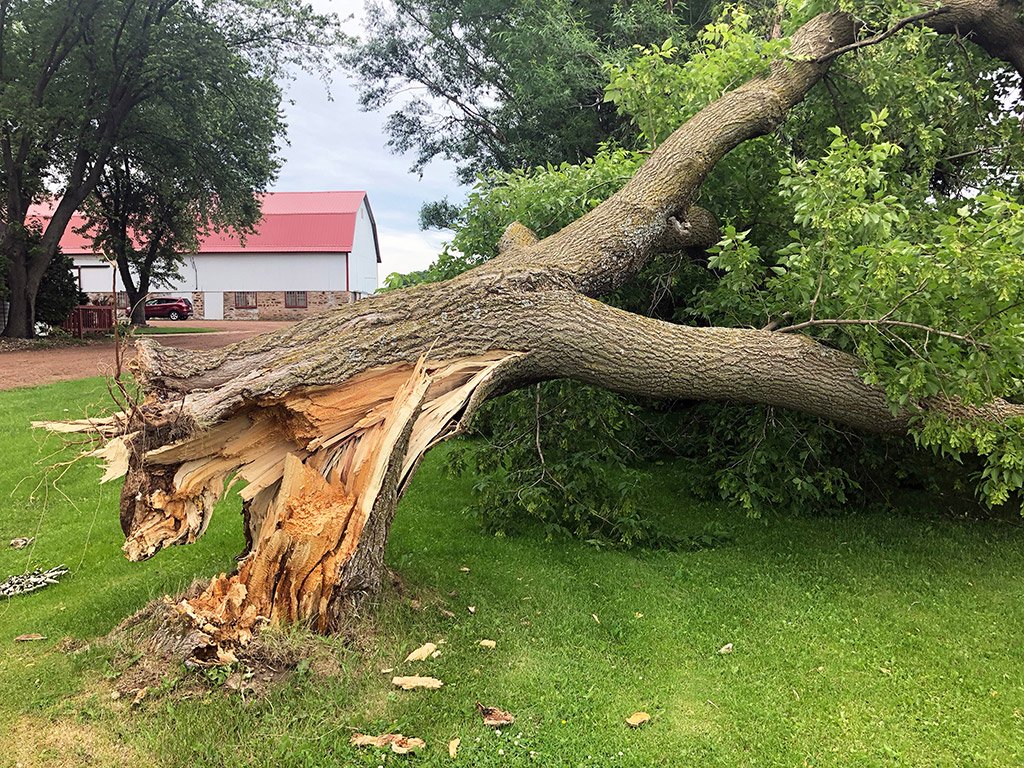
The housing is recent enough that the trees kept around it are only now reaching the size that can hurt a building. A pine spared at the back of a lot built in 2010 has spent fifteen years adding height and very little root depth, and that combination has not yet been tested by a real system. Meanwhile the storm record for the county is short and blunt: Helene brought gusts of 60 to 70 mph across Richland County and left eighteen homes destroyed with 232 others damaged, on top of trees and lines down, roads closed and neighbourhoods dark. What that says to a household on the northern edge of the county is that failures here are single stems, not flattened forest, and they land on buildings one at a time. A tree that has leaned since the clearing is exactly the shape that goes first. What the record does not show is the trees left standing with damage nobody dealt with — a split crotch, a hanger caught in a fork, a root plate lifted on the sheltered side of a house. Those come down in calm weather, months later, and nobody links them back to the storm.
Tree work around Blythewood
Frequently
Asked
Questions
Does a newer house mean less tree risk?
Not necessarily. A young lot is where the retained stems are still catching up with the building, and the first decade after a subdivision is built is when the edge trees are most exposed, because the shelter they grew up in has just been removed. The house being new tells you nothing about the trees; the clearing date does. On the streets built in the last decade the edge stems are also the ones nearest the drive, so a failure lands where the car sits rather than in the middle of a lawn.
What did Helene leave behind in Richland County?
The National Weather Service record lists trees and power lines down, some roads closed, sections of the county without power, a few structures damaged by falling trees, areas of flooding, gusts of 60 to 70 mph, and a total of eighteen homes destroyed with 232 others damaged. The figure that matters for a household is the 232: those were mostly single stems reaching single buildings, which is the pattern this town should expect from any wind in that band.
Why do the trees at the edge of a cleared lot lean toward the opening?
Because that is where the light is, and because the roots on the open side no longer have neighbours to hold against. A stem that grew in a crowd builds wood to resist being pushed by the trees beside it. Remove them and the same tree is suddenly unsupported on one flank, so it tips a little each season and puts eccentric weight into the trunk while it does it.
Does 513.7 feet of elevation change anything?
It changes exposure. Higher ground has fewer obstructions between it and the wind, so a system that arrives softened over lower country reaches this town with more of its strength left. It does not make trees weaker, but it does mean the tallest stem on an open lot is doing more work than its size suggests, which is worth knowing before a forecast.
What can go at the kerb after a take-down?
Richland County collects sticks and small limbs up to four feet long and four inches round, roughly two roll carts or six thirty-gallon bags a week, and sends larger loads to a drop-off centre. A removal produces far more than that allowance in a morning, so the material leaves with the crew and only the small rakings stay for collection.
Are the oaks here at risk from disease?
Clemson’s fact sheet describes Hypoxylon canker as a stress-related fungus that attacks weakened oaks, water oak and southern red oak among them, with drought stress the most significant factor in infection. This town has few old oaks, but the ones left at the edge of the older parcels are the ones that sit through dry summers with compacted ground around them, which is the condition the fungus looks for.
Not necessarily. A young lot is where the retained stems are still catching up with the building, and the first decade after a subdivision is built is when the edge trees are most exposed, because the shelter they grew up in has just been removed. The house being new tells you nothing about the trees; the clearing date does. On the streets built in the last decade the edge stems are also the ones nearest the drive, so a failure lands where the car sits rather than in the middle of a lawn.
The National Weather Service record lists trees and power lines down, some roads closed, sections of the county without power, a few structures damaged by falling trees, areas of flooding, gusts of 60 to 70 mph, and a total of eighteen homes destroyed with 232 others damaged. The figure that matters for a household is the 232: those were mostly single stems reaching single buildings, which is the pattern this town should expect from any wind in that band.
Because that is where the light is, and because the roots on the open side no longer have neighbours to hold against. A stem that grew in a crowd builds wood to resist being pushed by the trees beside it. Remove them and the same tree is suddenly unsupported on one flank, so it tips a little each season and puts eccentric weight into the trunk while it does it.
It changes exposure. Higher ground has fewer obstructions between it and the wind, so a system that arrives softened over lower country reaches this town with more of its strength left. It does not make trees weaker, but it does mean the tallest stem on an open lot is doing more work than its size suggests, which is worth knowing before a forecast.
Richland County collects sticks and small limbs up to four feet long and four inches round, roughly two roll carts or six thirty-gallon bags a week, and sends larger loads to a drop-off centre. A removal produces far more than that allowance in a morning, so the material leaves with the crew and only the small rakings stay for collection.
Clemson’s fact sheet describes Hypoxylon canker as a stress-related fungus that attacks weakened oaks, water oak and southern red oak among them, with drought stress the most significant factor in infection. This town has few old oaks, but the ones left at the edge of the older parcels are the ones that sit through dry summers with compacted ground around them, which is the condition the fungus looks for.